 I'll be appearing sometime during the 8 am hour of the Fox 26 Morning News telecast on Houston station KRIV/Channel 26 tomorrow, Sept. 23. Why? Well, they're doing a segment on the 70th anniversary of The Wizard of Oz, and they wanted someone to provide informed commentary. Well, either that, or they wanted someone who looks like a cowardly lion at that early hour. In any event, gets those TiVos warmed up now...
Tuesday, September 22, 2009
TV alert: 8 am Wednesday, Sept. 23
I'll be appearing sometime during the 8 am hour of the Fox 26 Morning News telecast on Houston station KRIV/Channel 26 tomorrow, Sept. 23. Why? Well, they're doing a segment on the 70th anniversary of The Wizard of Oz, and they wanted someone to provide informed commentary. Well, either that, or they wanted someone who looks like a cowardly lion at that early hour. In any event, gets those TiVos warmed up now...


Remarks about remakes
Since all of the really important critics were tied up with the Toronto Film Festival last week, CNN.com writer Grace Wong couldn't be choosy when she sought someone to interview for her story about movie remakes. So she had to resort to calling... well, me. But that's OK: She managed to write a fine story anyway.
Monday, September 21, 2009
Get Low gets a distributor

Sony Pictures Classics has acquired North American rights to one of the best movies to premiere at this year's Toronto Film Festival. Apparently, there is a God.
Themes like old times
If you were a fan of Easy Listening radio during the '60s and '70s, you couldn't avoid the musical stylings of Ferrante & Teicher. And, really, you wouldn't want to. The piano-playing duo recorded scores of LPs and charted several hit singles, running the gamut from Broadway standards to light classical works, but they remain most fondly memembered by movie buffs for their classy recordings of themes from The Apartment, Exodus, Midnight Cowboy, Pieces of Dreams, A Man and a Woman, Live for Life and dozens of other films. Louis Teicher passed away in August 2008. Over the weekend, Arthur Ferrante joined his fellow keyboardist in that great music hall in the sky.
For me, Ferrante & Teicher symbolize an era in movie-musicianship when a picture's title tune might prove more memorable -- and, through heavy rotation on Easy Listening radio, more enduring -- than the picture itself. Indeed, I wonder how many people even know that "Pieces of Dreams" -- also recorded by such notables as Barbra Streisand, Johnny Mathis and Shirley Bassey -- actually was a movie theme. For the record: It was an Oscar-nominated song composed by no less than a luminary than Michel Legrand for a long-forgotten 1970 flick starring Robert Forster as a Catholic priest undergoing a crisis of faith, and Lauren Hutton as a beautiful social worker who leads him into temptation. To be fair, I haven't seen the movie since its original theatrical release, so I can't say for certain whether it deserves its obscurity. But, hey, it obviously did a lot more for Ferrante & Teicher than it did for Forster or Hutton, right?
For me, Ferrante & Teicher symbolize an era in movie-musicianship when a picture's title tune might prove more memorable -- and, through heavy rotation on Easy Listening radio, more enduring -- than the picture itself. Indeed, I wonder how many people even know that "Pieces of Dreams" -- also recorded by such notables as Barbra Streisand, Johnny Mathis and Shirley Bassey -- actually was a movie theme. For the record: It was an Oscar-nominated song composed by no less than a luminary than Michel Legrand for a long-forgotten 1970 flick starring Robert Forster as a Catholic priest undergoing a crisis of faith, and Lauren Hutton as a beautiful social worker who leads him into temptation. To be fair, I haven't seen the movie since its original theatrical release, so I can't say for certain whether it deserves its obscurity. But, hey, it obviously did a lot more for Ferrante & Teicher than it did for Forster or Hutton, right?
Can the indie "bloodbath" be traced to the decline of critcis?
After surveying the scene at the just-completed Toronto International Film Festival, Anne Thompson reports on the sad state of the indie film market. (Like me, she's surprised to see that Get Low couldn't nail down a distribution deal during TIFF.) Roger Ebert echoes her insights -- and adds a few of his own -- here.
For what it's worth, I posted this comment on Ebert's blog (which, like Thompson's, is required reading for any serious cinéaste):
I strongly suspect that, years from now, when pop-culture historians are writing about the early-21st-century indie film crisis, many will note a direct correlation between the decline in audiences for indie films and the decline of film critics on newspapers in major and secondary markets. Seriously. Yes, I know: Newspapers still run wire-service reviews. But that’s hardly the same thing as having someone on staff who’s an active advocate for indie movies, who’s eager to interview indie filmmakers – and who urges editors to occasionally make a review of an indie film the lead review in a Friday paper. Also: I think readers are more likely to heed the advice of a critic they have come to know, if not always agree with. That is, a critic who is a visible member of the community – someone who’s interviewed on local TV from time to time, who lectures and/or introduces films at museums and other venues, and whose reviews may get debated on radio talk shows.
Of course, there’s another factor to consider: The decline of newspapers, period. Yes, there are many, many websites where people can read astute and/or entertaining reviews of films. But those sites are frequented by people already inclined to see movies. With newspapers, you have what I call The Happenstance Factor: Someone leafing through the paper might stumble across a review of an indie movie – a movie he or she might not otherwise know about – and become sufficiently interested to actually go see the film in a first-run theater. I can’t tell you how many times I had people (even editors and fellow staffers) tell me back when I reviewed films for the now-defunct Houston Post that they never would have heard about (much less gone to see) certain movies if they hadn’t serendipitously come across my review while looking for the comics page or the horoscope column. Unfortunately, that sort of thing rarely happens on the Internet.
For what it's worth, I posted this comment on Ebert's blog (which, like Thompson's, is required reading for any serious cinéaste):
I strongly suspect that, years from now, when pop-culture historians are writing about the early-21st-century indie film crisis, many will note a direct correlation between the decline in audiences for indie films and the decline of film critics on newspapers in major and secondary markets. Seriously. Yes, I know: Newspapers still run wire-service reviews. But that’s hardly the same thing as having someone on staff who’s an active advocate for indie movies, who’s eager to interview indie filmmakers – and who urges editors to occasionally make a review of an indie film the lead review in a Friday paper. Also: I think readers are more likely to heed the advice of a critic they have come to know, if not always agree with. That is, a critic who is a visible member of the community – someone who’s interviewed on local TV from time to time, who lectures and/or introduces films at museums and other venues, and whose reviews may get debated on radio talk shows.
Of course, there’s another factor to consider: The decline of newspapers, period. Yes, there are many, many websites where people can read astute and/or entertaining reviews of films. But those sites are frequented by people already inclined to see movies. With newspapers, you have what I call The Happenstance Factor: Someone leafing through the paper might stumble across a review of an indie movie – a movie he or she might not otherwise know about – and become sufficiently interested to actually go see the film in a first-run theater. I can’t tell you how many times I had people (even editors and fellow staffers) tell me back when I reviewed films for the now-defunct Houston Post that they never would have heard about (much less gone to see) certain movies if they hadn’t serendipitously come across my review while looking for the comics page or the horoscope column. Unfortunately, that sort of thing rarely happens on the Internet.
Iconic Amelia
 Just in time for moviegoers to prepare themselves for the Oct. 23 release of Amelia -- Mira Nair's eagerly awaited biopic about Amelia Earhart, with Oscar-winner Hilary Swank in the title role -- The New Yorker offers Judith Thurman's fascinating account of the legendary aviatrix and her final flight. The money quote: "There were, in fact, other famous female aces in the early decades of aviation. All of them were daring—some were said to be better pilots than Earhart—and many of them were killed and forgotten. If Earhart became an 'icon,' it was, in part, because women who aspired to excel in any sphere, at a high altitude, looked upon her as their champion. But it was also because the unburied come back to haunt us."
Saturday, September 19, 2009
To Patrick Swayze, thanks for everything
 While combing through my archives, I found this interview I did with Patrick Swayze during the 1995 New York junket for To Wong Foo, Thanks for Everything, Julie Newmar. It was a movie, he admitted, for which he had to struggle to land an audition -- because, evidently, no one involved thought he was right for the part of Vida, a drag queen performer.
"Early on," Swayze said, "when I first heard about it, I couldn't even get a script for it. And my agent couldn't get me in (for an interview), and they wouldn't see me, because, you know, Patrick Swayze is terminally macho. It wasn't until the end, when they had exhausted all their other possibilities, that I got to go in."
And even then, Swayze wasn't allowed to see the script until a few hours before the audition. He read a few pages, saw that Vida has several long speeches, and immediately realized he didn't have time to properly prepare.
"So I told them, `Look, I can't do these words. So if this is a case where I have to do these words, forget it. But if you let me come in, I'll give you a half-hour monologue on my life as a drag queen, and see if I can turn into Vida while I watch her materialize in the mirror.'
"And I wound up giving them an hour-long monologue. I just took Patrick Swayze's life, and told it as if he'd grown up as a drag queen in Texas. And that was a neat story. " Yes, indeed.
Tuesday, September 15, 2009
TIFF review: Harry Brown
 It’s tempting, and not entirely inaccurate, to describe Harry Brown as a geriatric Death Wish
 , though many wags more likely will blurb it as Michael Caine’s Gran Torino
 . Either way you look at it, this bleakly gripping and sporadically exciting drama about a retired soldier who takes aim at young hoodlums (and their not-so-young enablers) in his London public-housing apartment complex could generate respectable theatrical coin and impressive homevideo action. And while it should skew toward older audiences, many younger ticketbuyers may be curious to see some serious ass-kicking by the actor they know best as Batman’s butler. You can read my Variety review here.
Monday, September 14, 2009
R.I.P.: Patrick Swayze (1952-2009)
 Please don’t misunderstand: Patrick Swayze and I weren’t bowling buddies or anything like that, and I don’t want to sound like I’m trying to pass myself off as someone grieving for a close, personal friend. But I find myself deeply saddened by his demise – and, yes, more than a little peeved that, being caught up in the Toronto Film Festival right now, I don’t have nearly enough time to write a farewell worthy of the guy.
Our paths crossed several times over the years, due in no small measure to the fact that he was a Houston native, and I started interviewing him for The Houston Post as far back as The Outsiders (1983). I have very happy memories of a lunch we shared at a downtown H-Town restaurant in 1987, just before Dirty Dancing opened. He knew he was the verge of a major career breakthrough – and he was so openly, eagerly exuberant that I experienced a kind of contact high just sitting near him.
I remember an uproarious incident during the press junket for Point Break in the Loews Santa Monica Beach Hotel. I was walking toward my room after a morning of roundtable interviews when I heard Swayze shouting my name from across the atrium. When I turned to respond, I saw he was on a floor two stories above mine, with one leg draped over the railing, pretending he was preparing to dive into the lobby far below. So I had to shout back in response: “Don’t do it, Patrick! You have so much to live for! The movie’s not that bad!” He laughed so hard, I momentarily feared he might lose his balance and really take the drop. I laughed, too, but I didn’t actually smile until he took his leg off the railing.
I don’t pretend to have known the man very well, but, as I say, I always enjoyed talking with him, and always appreciated his seemingly boundless enthusiasm. I cannot believe there isn’t a place somewhere on the other side where such a vital spirit can continue to thrive. More, later.
I don’t pretend to have known the man very well, but, as I say, I always enjoyed talking with him, and always appreciated his seemingly boundless enthusiasm. I cannot believe there isn’t a place somewhere on the other side where such a vital spirit can continue to thrive. More, later.
TIFF review: Get Low
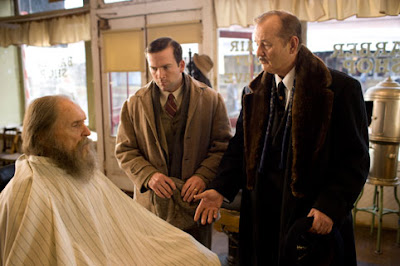 With meticulously variegated measures of sly humor, homespun grace and affecting poignancy, Get Low casts a well-nigh irresistible spell while spinning a Depression Era folk tale from the Tennessee backwoods. Robert Duvall compellingly underplays the larger-than-life lead role of Felix Bush, a notorious hermit who rejoins society only to plan his own funeral party, and he’s backed by smartly cast supporting players (including Bill Murray and Lucas Black) who clearly savor the twofer of portraying vividly drawn characters opposite an Oscar-winning living legend. Appreciative reviews and savvy marketing could attract adult ticketbuyers, especially if this polished indie production emerges as a credible contender for glittering prizes. You can read my complete Variety review here.
Friday, September 11, 2009
A few quick words from TIFF
Lightining struck twice for me today during back-to-back press screenings at the Toronto Film Festival. Joel and Ethan Coen's A Serious Man is a low-key, pitch-perfect, straight-faced absurdist dark comedy with a surprisingly affecting impact. And, better still, an ending bound to piss off even more people than the ending of No Country for Old Men. I strongly suspect it will richly reward repeated viewings. The same can be said for Jason Reitman’s Up in the Air, which may be… oh, to hell with equivocation. It is the best movie I have seen so far in 2009. If I see anything better by year’s end, I will be greatly astonished and immensely grateful. But I’ll still probably want to go back and take another look at Reitman’s film – and at George Clooney’s career-highlight performance – just to be absolutely certain the other movie really is better.
More to come...
More to come...
Thursday, September 10, 2009
Sunday, August 30, 2009
Review: The Open Road
 For reasons I don’t begin to understand, the distributors of The Open Road opted to open their low-key dramedy in Houston and a few other markets last Friday without bothering to screen it in advance for critics. Usually, such an under-the-wire release is a sure-fire indication that (a) the movie in question is a great big steaming turd, and (b) the distributor, well aware of this fact, wants to take the money and run. But here’s the thing: In this case, a lot of people who don’t usually see a lot of movies in theaters – i.e., folks in the 35-plus demographic -- might have been willing to shell out the shekels for first-run admission tickets if only they’d known what the movie was about, and who’s in it, and how engaging it is.
Don’t misunderstand: We’re not talking about the unwarranted dump of an indisputable instant classic. But we are talking about the mishandling of a good movie that, months from now, people will discover in the Redbox kiosk at their neighborhood grocery store, or the VOD schedule of their cable-TV service, and enjoy. And those people likely will think, “Wow, how did we miss this one? Did it open in theaters at all?” You can read my Variety review here.
Thursday, August 27, 2009
Honoring a Straight Shooter
 Sharpshooter Joe Bowman was known professionally and affectionately as "The Straight Shooter" -- and, better still, "The Master of Triggernomics" -- because of his flamboyant showmanship and dazzling prowess as a marksman. He rubbed shoulders with notables ranging from Roy Rogers to Sammy Davis Jr. -- and taught Robert Duvall how to handle a very special firearm while playing a former Texas Ranger in Lonesome Dove. I met Bowman on a few occasions during his visits to the Houston offices of Cowboys & Indians magazine, and was always impressed by his courtly manner and vivid storytelling. He passed away last June -- while on his way back home to Houston after a rootin'-tootin'-shootin' performance in Albuquerque --and was posthumously inducted into the Texas Heroes Hall of Honor at the Frontier Times Museum in Bandera, Texas, just one month later. It was my privilege to help produce this tribute video honoring The Straight Shooter.
Wednesday, August 26, 2009
Variety strikes again!
 Looks like the distributors of The Final Destination made the same mistake as the folks who released G.I. Joe: A "no press previews" policy means nothing to an international publication.
An art-house renaissance in The Big Easy?
Take this with a grain or two of salt -- or, more appropriately, a bag of popcorn -- but maybe things really are on the rebound in my hometown of New Orleans four years after Hurricane Katrina. That's the only way I can explain why one local theater-industry veteran thinks it's a financially sound idea to expand, of all things, a Canal Street theater devoted to indie and foreign films.
Invisible Girlfriend should be seen
 Glad to see someone else waxing enthusiastic about David Redmon and Ashley Sabin's Invisible Girlfriend. You can buy a copy of the DVD -- and, while you're at it, a copy of Kamp Katrina, a fascinating documentary about post-Katrina New Orleans by the same filmmakers -- here.
Tuesday, August 25, 2009
Fight cancer with Team Duke
John Wayne died 30 years ago this summer. My father died three years ago this month. My friend Al Shea died last week. Here's a way to raise money to fund the fight against their killer.
Team Duke 1 minute spot from Team Duke on Vimeo.
Saturday, August 22, 2009
Old Man Leydon
To paraphrase a posting from last year: Another birthday, another reminder of just how ancient I am becoming. Today, I turn 57. Consider: I am now two years older than Humphrey Bogart was when he played Lt. Comdr. Queeg in The Caine Mutiny. (Worse, I’m roughly the same age he was when he freakin' died.) I am now three years older than James Stewart was when he starred in The Man Who Shot Liberty Valance. I am five years older than Walter Brennan was when he played Old Man Clanton in My Darling Clementine, and John Wayne was when he starred in Rio Bravo. I am seven years older than Claude Rains was when he co-starred in Mr. Smith Goes to Washington. I am 14 years older than Lee Marvin was when he took command of The Dirty Dozen. When I consider how old I used to think those guys looked in those movies….
Friday, August 21, 2009
A fond farewell to Al Shea
Some kids dream of becoming baseball stars or basketball champs. Others want to become cops or firefighters. Me? Well, I have to admit, for a goodly portion of my youth in New Orleans, I wanted to grow up to be Al Shea. Seriously.
For a decade or so in the 1960s and ‘70s, Shea was the exuberantly gregarious entertainment reporter for Midday, a live noontime variety show that aired on NBC affiliate WDSU-TV. Whether he was reviewing new films – I vividly recall his politely dismissive WTF response to The Illustrated Man – or appraising local stage productions, or smoothly interviewing showbiz celebrities either in town or on the road, he came across at once informed and accessible, well-connected and down-to-earth, thoroughly professional and ingratiatingly easygoing. I didn’t fully appreciate at the time that, as New Orleans TV historian Dominic Massa points out in his on-line tribute, Shea was one of the first people to do on-the-air reviews of movies and plays on American television. And I made only a sporadically effective effort to tamp down my profound jealousy of the guy. But that’s only because I wasn’t merely a fan of Al Shea -- I wanted to be Al Shea. Because, geez, he had such a cool job, and he looked like he was enjoying every moment of it.
Long after Midday signed off for good, Al remained a fixture in New Orleans media, covering arts and entertainment for the Guide weekly newspapers and, for 23 years, serving as an influential theater critic for Steppin’ Out, the long-running and enduringly popular weekly roundtable program dedicated to local entertainment on PBS station WYES. He also appeared on other television stations in various other capacities -- indeed, he was a New Orleans TV staple for some 50 years -- and fully qualified as the local hero equivalent of a living legend.
Early in my career, while I was a fresh-faced free-lancer for various small N.O. papers as an entertainment columnist, Al was unfailingly gracious and sincerely encouraging whenever our paths crossed at local theater premieres or New York movie junkets. (He also was a generous benefactor when, during a Big Apple junket for Lenny, he lent me cab fare to the airport after my wallet had been rifled by, ahem, a passing stranger.) Our paths ultimately diverged, of course, and I lost track of the guy for about three decades. But when we met again last spring, during my return visit to N.O. for a guest spot on Steppin’ Out, I was greatly pleased (and, yes, more than a little honored) that he greeted me as an old chum from way back when.
And when the time came for the actual taping, and I found myself actually sitting near Al alongside the other Steppin’ Out regulars, and actually swapping quips with him throughout the show… Well, let me put it like this. Years ago, I found myself seated next to Andrew Sarris and Molly Haskell on a film festival panel. Years before that, Judith Crist called on me from her podium to supply her with a movie title she couldn’t remember while lecturing at Loyola University of New Orleans. How did I feel on those occasions? Pretty much how I felt during the Steppin’ Out taping.
Al died Thursday of cancer at age 80. On Saturday, I will turn 57. If I can remain as involved and enthusiastic as Al was the last time I saw him, and I’m still able to express my love for film as intelligently and joyfully as he expressed his love for local theater during that Steppin’ Out episode, for another 23 years… I’ll probably ask for another 23, or more, of the same. And I'll still be thanking Al Shea for being one of my early inspirations.
Subscribe to:
Posts (Atom)